

How Can You Determine the Right Time for Sandblasting? 3 Key Points and More
How Can You Determine the Right Time for Sandblasting? 3 Key Points and More
How do you determine the right time for sandblasting? A guide to the ideal time for sandblasting based on surface condition, pre-coating preparation, and production processes.
How Can You Determine the Right Time for Sandblasting?
Determining the right time for sandblasting is a critical decision that directly affects surface quality and coating performance in industrial production.
In many businesses, sandblasting is viewed as a process performed only “when necessary.” However, this approach can lead to coating defects, unnecessary costs, and production losses.
In fact, sandblasting, when done at the right time:
- Maximizes coating adhesion
- Reduces the risk of corrosion
- Increases production efficiency
For this reason, the question “When should sandblasting be performed?” is fundamental to process optimization.
1. Surface Condition: The First and Most Critical Factor
The most important factor in determining the right time for sandblasting is the current condition of the surface.
The following situations directly indicate the need for sandblasting:
- Rust and Oxide Formation
- Residues of old paint or coatings
- Oil, dirt, and surface contamination
- Non-homogeneous surface structure
If such problems exist on the surface, proceeding with the coating process without first sandblasting the surface will lead to serious quality issues.
👉 Key point:
Even surfaces that appear clean to the naked eye may not be suitable for coating at the microscopic level.
2. Timing Before Coating (The Most Common Mistake)
After the sandblasting process is complete, the surface becomes sensitive to environmental factors.
In particular:
- Humidity
- Exposure to air
- Ambient temperature
Factors such as these can cause rapid oxidation on the surface.
For this reason, the time interval between sandblasting and coating is of critical importance.
Ideal scenario:
✔ Sandblasting → Coating in a short time
High-risk scenario:
❌ Sandblasting → waiting → oxidation → coating defect
👉 Industry standard:
In many applications, the coating process following sandblasting should be performed as quickly as possible.
3. Production Process and Operations Planning
The right time for sandblasting depends not only on the surface but also on production scheduling.
Poor timing leads to the following problems:
- Waiting times on the production line
- Excess inventory and accumulation of work-in-progress
- Need for re-sandblasting
Proper planning, on the other hand, is:
✔ Ensures a continuous flow
✔ Reduces operating costs
✔ Increases process efficiency
👉 Sandblasting should not be a “bottleneck” in the production line, but rather an optimized part of it.
Additional Factors to Consider When Determining the Right Time for Sandblasting
Environmental Conditions
- High humidity → rapid rusting
- Outdoor applications → faster surface degradation
Material Type
- Carbon steel → oxidizes quickly
- Stainless steel → more stable, but surface preparation is critical
Abrasive and Process Parameters
Incorrect abrasive or low pressure:
- Inadequate cleaning
- Need for re-sandblasting
This, in turn, directly affects the timing.
When Should Sandblasting Not Be Performed?
This is just as important as “when it should be done.”
Sandblasting should be postponed under the following circumstances:
❌ If the coating cannot be applied immediately
❌ If environmental conditions are uncontrolled
❌ If the appropriate equipment or abrasive is not available
Otherwise, the sandblasting process will result in reprocessing costs.
Right Timing = Lower Costs
When sandblasting is not timed correctly:
- A double transaction cost is incurred
- Coating defects increase
- This results in a loss of labor and time
With proper planning:
✔ Accurate results in a single pass
✔ Less consumables
✔ Longer coating life
is obtained.
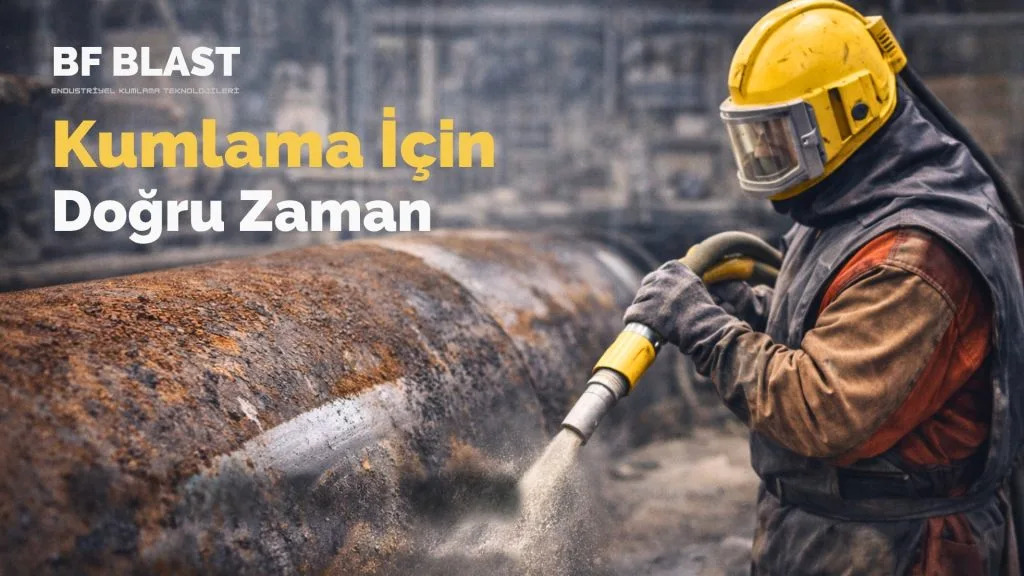
The BF BLAST Approach: Process-Oriented Sandblasting
The BF BLAST Approach: Process-Oriented Sandblasting
At BF BLAST, we view sandblasting not merely as a procedure, but as a process optimization.
In this context:
- Timing Analysis
- Surface and Coating Requirements
- Selecting the Appropriate System and Abrasive
- Production Line Integration
We provide our customers with technical solutions for critical areas such as these.
Conclusion
Determining the right time for sandblasting:
👉 Surface quality
👉 Coating performance
👉 Total cost
It has a direct effect on it.
It should not be forgotten that:
Sandblasting at the wrong time = rework + extra cost
Sandblasting done at the right time = quality + efficiency + profit
Frequently Asked Questions (FAQ)
When should sandblasting be done?
Before coating, the surface must be sandblasted if there is rust, dirt, or old coating on it.
How soon after sandblasting should painting be done?
It should be done as soon as possible. The longer you wait, the more the surface oxidizes.
What happens if sandblasting isn’t done?
The coating cannot adhere to the surface, leading to premature peeling and corrosion.
Related Articles
- What Is Sandblasting?
- How Is Sandblasting Done?
- Sandblasting Abrasives
- Types of Sandblasting Machines
Contact
If you want to reduce actual costs and standardize surface quality in your sandblasting process, let’s analyze the process together.
Let us evaluate your current system in terms of abrasive selection, process parameters, and timing to provide you with the optimal solution that will deliver measurable performance and cost benefits.
👉 Contact us now for sandblasting optimization tailored to your production needs.
🌐 www.bfblast.com
📞 +90 312 395 25 50

Contact Us
Technological Solutions
Açık iletişime inanır, insanlara değer verir ve teknolojimiz ile fark yaratırız.
Teknoloji ve çözümlerimiz hakkında bilgi almak için lütfen bizimle iletişime geçin.

