

Why Does Paint Blister After Sandblasting? 7 Key Reasons
Why Does Paint Blister After Sandblasting? 7 Key Reasons
Learn the most common causes of paint blistering and peeling after sandblasting. Extend the life of your coating by preventing surface preparation errors.
Why Does Paint Blister or Peel After Sandblasting?
When a freshly painted steel structure, tank, chassis, or machine part begins to blister within a few months, it represents a significant cost for businesses. When production losses, re-sandblasting, additional paint costs, and labor expenses are taken into account, a coating problem that may seem minor can have major financial consequences.
At this point, many people assume the problem stems from the quality of the paint. However, the vast majority of issues encountered in industrial surface preparation and coating processes begin long before the paint is even applied.
The fact is that the main cause of paint blistering and peeling is often inadequate surface preparation.
So why does paint blister or peel after sandblasting?
The answer to this question lies not only in the choice of paint, but also in the sandblasting standard, surface roughness, choice of abrasive, moisture control, and application conditions.
Why Is Paint Blistering and Peeling So Important?
The primary purpose of coating systems is to protect metal from environmental factors.
When the coating peels away from the surface;
- The corrosion process accelerates
- Structural strength decreases
- Maintenance costs rise
- Equipment lifespan is reduced
- Operational reliability decreases
Coating failure can lead to serious economic losses, particularly in steel structures, power plants, ships, storage tanks, and heavy industrial equipment.
For this reason, accurately identifying the source of the problem is of critical importance.
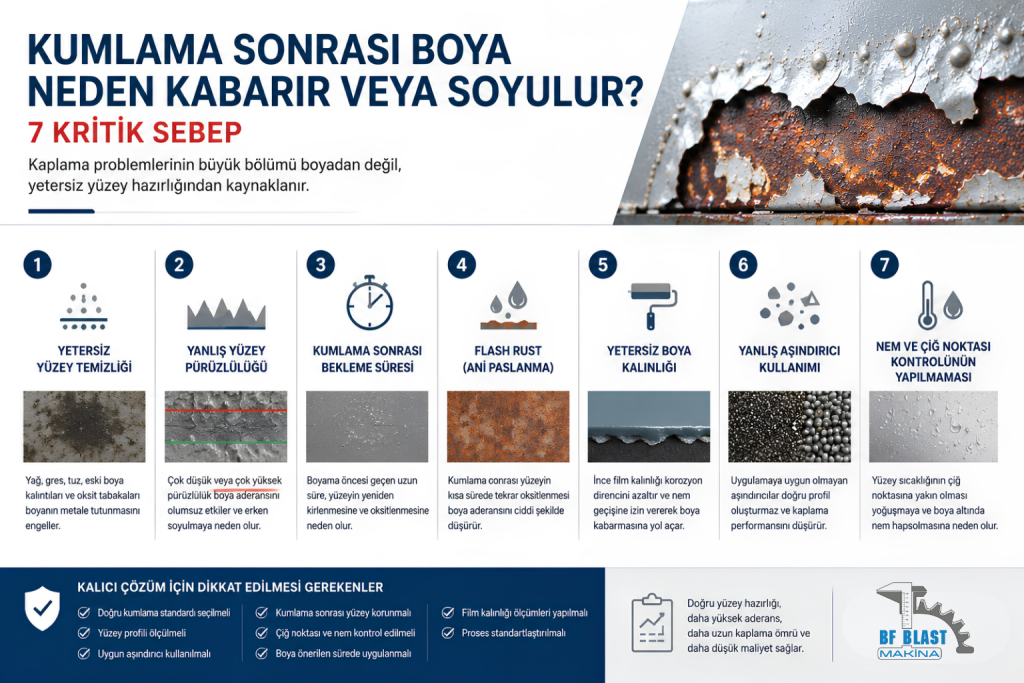
Why does paint blister or peel after sandblasting? Coating defects caused by inadequate surface preparation, incorrect surface roughness, moisture, and flash rust.
1. Inadequate Surface Cleaning
One of the biggest enemies of coating systems is the contaminants left on the surface.
Remaining on the surface before or after the sandblasting process;
- Oil
- Grease
- Salt deposits
- Oxide layers
- Old paint residue
- Welding slag
It can prevent the paint from coming into direct contact with the metal.
This may not be apparent at first. However, over time, the bond between the paint and the metal weakens, and the coating begins to peel away from the surface.
For this reason, it is not enough for the surface to simply look clean. The level of cleanliness must be verified in accordance with international standards.
Sa 2.5 surface preparation is one of the most commonly used standards, particularly for heavy-duty coatings.
2. Incorrect Surface Profile
While many businesses focus on surface cleaning, they overlook surface roughness.
In fact, this is one of the most critical factors determining coating adhesion.
The microscopic peaks and valleys formed after sandblasting allow the paint to adhere mechanically to the surface.
If the roughness is low:
- The paint doesn’t adhere well enough
- The coating peels off easily
- The risk of being robbed increases
If the roughness is excessively high:
- Paint consumption increases
- Thin-film regions form
- Early wear occurs at the peaks
For this reason, an appropriate surface profile must be created for each coating system.
3. Extended Painting Time After Sandblasting
Once the sandblasting is complete, the surface will not remain clean forever.
When the surface is left in the open air;
- Dust may accumulate
- Humidity may start to have an effect
- Atmospheric pollutants can adhere to surfaces
Especially in areas with high humidity, surface quality can deteriorate even within a few hours.
For this reason, the sandblasting and painting processes should be scheduled as close together as possible.
4. Flash Rust (Sudden Rusting)
Flash rust is one of the most common causes of painting problems after sandblasting.
A metal surface that has been completely cleaned by sandblasting can oxidize again very quickly, especially in humid environments.
This situation;
- In coastal applications
- At shipyards
- In open-air projects
- In regions with high humidity
is more common.
Even if the surface appears clean to the naked eye, a microscopic layer of rust may have formed.
This thin layer of paint can significantly reduce adhesion.
5. Incorrect Choice of Abrasive
Not every abrasive is suitable for every application.
Each of these abrasives—such as steel grit, steel shot, garnet, aluminum oxide, or glass beads—creates a different surface profile.
For example;
Steel Grit
- Creates a sharp profile
- Suitable for heavy-duty coating systems
Steel Ball
- Provides a rounder profile
- It is preferred for surface hardening applications
Glass Sphere
- Suitable for delicate surfaces
- It has low abrasiveness
Choosing the wrong abrasive can directly affect coating performance.
6. Failure to Monitor Humidity and Dew Point
In professional coating applications, not only temperature but also the dew point is monitored.
Condensation may occur when the surface temperature is very close to the dew point.
In this case:
- Moisture may remain under the paint
- Bubbles may form in the coating
- Corrosion may begin early
International standards generally recommend that the surface temperature be at least 3°C above the dew point.
If this inspection is not performed, paint blistering may become inevitable.
7. Inadequate or Improper Paint Application
Every paint system has a specific dry film thickness (DFT) requirement.
When the thickness is insufficient;
- The protective barrier effect decreases
- Moisture transfer accelerates
- Corrosion is more likely to occur
In cases of excessively thick applications, however;
- Cracks may form
- Internal stresses may occur
- The coating may peel off the surface
For this reason, the paint manufacturer’s technical data sheets should be consulted.
How Can You Prevent Paint from Blistering and Peeling?
The following steps are critical for improving coating performance:
✔ The correct sandblasting standard must be applied
✔ Surface roughness should be measured
✔ The appropriate abrasive should be selected
✔ The waiting period after sandblasting should be kept to a minimum
✔ Check for Flash rust
✔ Humidity and dew point should be measured
✔ Paint thickness should be checked regularly
✔ Coating procedures should be standardized
Thanks to these inspections, the coating’s lifespan can be extended by several years.
Sandblasting and Painting Are Not Separate Processes
One of the biggest mistakes made on-site stems from treating sandblasting and painting as separate processes.
In fact, a successful coating system;
- Proper Surface Cleaning
- Correct surface profile
- The right environmental conditions
- Proper Paint Application
is composed of.
Even the best paint will fail on a poorly prepared surface.
However, a properly prepared surface can significantly improve the performance of even an average paint system.
Conclusion
Paint blistering or peeling after sandblasting is often caused not by the quality of the paint, but by errors in the surface preparation process.
Thanks to proper surface cleaning, appropriate surface roughness, the right choice of abrasive, and controlled application conditions:
- Higher adherence
- Longer coating life
- Lower maintenance costs
- Higher corrosion resistance
It is possible to achieve this.
The success of the coating is determined not when the paint can is opened, but when the sandblasting process begins.
Prevent Coating Problems Before They Start
Most of the problems encountered in coating systems can be prevented with the right equipment and proper process management.
At BF BLAST, we don’t just manufacture sandblasting machines; we also provide technical expertise and engineering support to help optimize surface preparation processes.
If you want to extend the lifespan of your coatings, reduce coating costs, and improve surface preparation performance at your facility, please contact our team of experts.
For a Free Technical Assessment
📍 Ostim OSB, 1247th St., No. 9, Yenimahalle / Ankara
📞 +90 312 395 25 50
🌐 BF BLAST
Instead of trying to fix coating problems after they arise, design your process correctly from the start. Long-lasting coatings begin with proper surface preparation.

Contact Us
Technological Solutions
Açık iletişime inanır, insanlara değer verir ve teknolojimiz ile fark yaratırız.
Teknoloji ve çözümlerimiz hakkında bilgi almak için lütfen bizimle iletişime geçin.


