

What Is Sandblasting? How Is Industrial Sandblasting Performed, and Why Is It Necessary?
What Is Sandblasting? How Is Industrial Sandblasting Performed, and Why Is It Necessary?
What is sandblasting?
What is sandblasting: It is the process of using abrasive materials to clean metal and similar surfaces in a controlled manner to remove rust, oxide, oil, and residues of old coatings. However, sandblasting is not merely a cleaning method; it is the most critical stage of surface preparation prior to painting and coating.
Paint or coatings applied without sandblasting cannot mechanically adhere to the surface and will peel off within a short time.
In the world of industrial manufacturing, the quality of the final product often depends on the preparatory stage—which lies beneath the surface and is invisible to the eye. Sandblasting is not merely a cleaning process; it is an engineering discipline that serves as the cornerstone of major industries ranging from aerospace to defense, and from automotive to energy. In this comprehensive guide, we will delve into the depths of sandblasting technology and examine why it is vital for your business, backed by technical data.
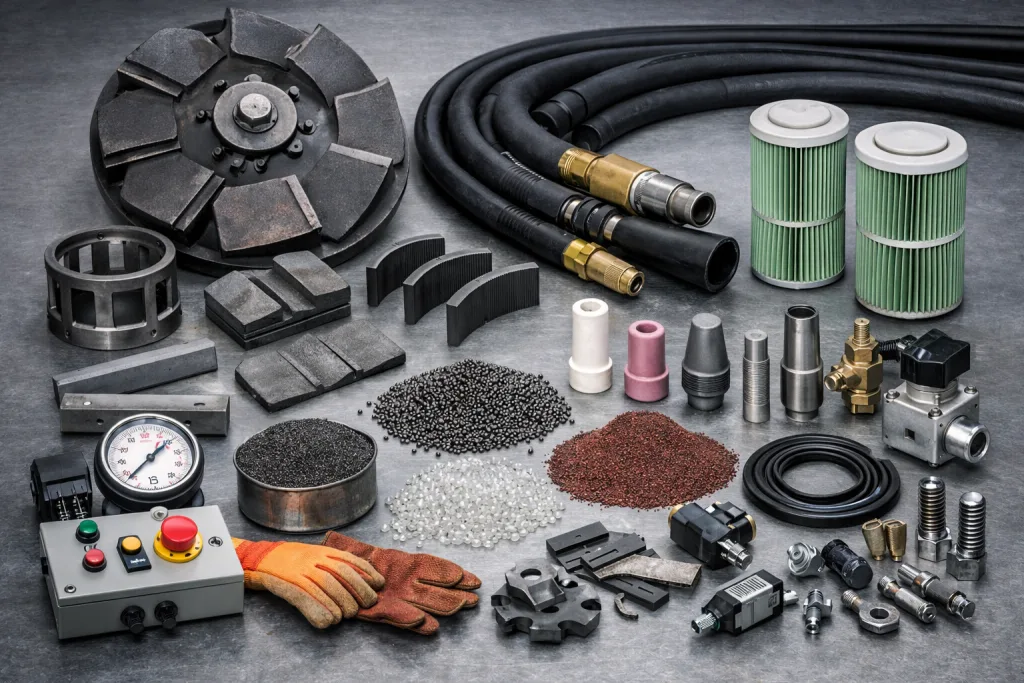
Sandblasting materials
Why Is Sandblasting Necessary? What Is Its Importance?
A surface that has not been sandblasted is doomed to rot from the inside out, no matter how well it is painted.
-
Corrosion Prevention: When moisture and air become trapped beneath the metal, corrosion progresses from the inside out; sandblasting eliminates these risks at the source.
-
Cost Savings: Proper sandblasting extends maintenance intervals by up to 300%, resulting in massive long-term savings.
-
Compliance with Standards: The Sa 2, Sa 2.5, and Sa 3 cleanliness levels specified in the international ISO 8501-1 standards can only be achieved through professional sandblasting.
A properly performed sandblasting process, on the other hand:
-
Extends the life of the coating
-
Increases surface strength
-
Reduces paint consumption
-
It reduces costs in the long run
For this reason, the sandblasting process is not a matter of choice in industry, but a mandatory production step.
Sandblasting is not only a technical necessity but also offers businesses significant cost advantages. Proper sandblasting practices can extend maintenance intervals by up to three times. This helps businesses both reduce maintenance costs and ensure production continuity. In the long term, sandblasting reduces paint consumption, extends the life of coatings, and increases surface durability. This chain reaction translates into significant savings in total production costs.
Compliance with international standards is another factor that underscores the importance of sandblasting. The Sa 2, Sa 2.5, and Sa 3 cleanliness levels specified in the ISO 8501-1 standards can only be achieved through professional sandblasting. These standards define how clean a surface must be prior to coating. The Sa 2.5 and Sa 3 levels represent the highest quality in the industry. Achieving these levels is critical for products to gain acceptance in the international market and earn customer trust.
How Is Sandblasting Done? (Step-by-Step Guide to Industrial Sandblasting)
The answer to the question “How is sandblasting done?” is a controlled process:
-
Surface Analysis: The material type and rust level are determined
-
Abrasive Selection: Choose steel grit, steel shot, or mineral abrasive
-
Machine Selection: Determine whether to use a manual or automatic sandblasting system
-
Application: Pressure, speed, and angle are optimized
-
Inspection: Inspected in accordance with Sa 2.5–Sa 3 standards
Each stage directly affects the final surface quality.
The sandblasting process is a systematic sequence consisting of surface analysis, abrasive selection, machine parameter adjustment, application, and inspection. If any link in this chain is missing or performed incorrectly, the coating’s service life is shortened, surface durability decreases, and costs increase. When performed correctly, however, sandblasting ensures long-lasting coatings, low maintenance costs, and high customer satisfaction.
In conclusion, sandblasting is a process in industrial production that should not be left to chance. Meticulous execution of every step ensures not only a clean surface but also a reliable and sustainable quality standard.
Differences Between Automatic and Manual Sandblasting
Manual Sandblasting
-
Suitable for low-volume and custom parts
-
It depends on the operator’s skill
-
It is flexible but may produce non-standard results
Automatic Sandblasting
-
Ideal for mass production
-
Ensures consistent and repeatable surface quality
-
It saves time and labor
If the goal is to achieve industrial-scale quality, automatic sandblasting systems are the preferred choice.
For small-scale manufacturers, manual sandblasting may initially seem attractive due to its lower initial investment cost. However, for companies aiming for mass production, automated sandblasting systems are essential. This is because these systems not only increase production speed but also ensure surface quality that complies with international standards. Achieving the Sa 2.5 and Sa 3 cleanliness grades defined in ISO 8501-1 is much easier with automated sandblasting.
In conclusion, while manual sandblasting is suitable for flexibility and low-volume production, automatic sandblasting is a solution that guarantees quality in high-volume production. Selecting the right system by considering your company’s scale, production goals, and quality expectations is a critical investment decision in terms of both long-term costs and customer satisfaction.
What Are the Different Types of Sandblasting?
Drum Blasting
Used for small and medium-sized production parts. Ideal for bolts, castings, and fasteners.
Pipe Sandblasting
It ensures uniform sandblasting of both the inner and outer surfaces of pipes. It is widely used in the energy and infrastructure sectors.
Wet Sandblasting
It provides a dust-free working environment. It is preferred for sensitive surfaces and specialized applications.
Sandblasting Cabins
It offers secure and controlled solutions for manual applications.
Ultimately, the choice of blasting method depends on production requirements. Drum systems are best suited for small parts produced in series; hanging systems for large and complex parts; pipe blasting for energy and infrastructure applications; sheet metal and profile blasting for steel construction; and wet blasting for precision surfaces. Choosing the right type of blasting directly affects not only surface quality but also production efficiency and customer satisfaction.
Why Is Choosing a Sandblasting Machine Important?
Choosing the wrong sandblasting machine can lead to the following problems:
-
Inadequate surface quality
-
Excessive abrasion
-
Waste of energy and abrasives
-
Short machine lifespan
For this reason , sandblasting machines should be considered custom systems rather than standard products.
BF BLAST Industrial Sandblasting Solutions
BF BLAST, as one of the leading companies in Turkey’s sandblasting industry;
-
Pipe sandblasting machines
-
Sandblasting Booths
-
Spare Parts and Technical Service
provides industrial-scale solutions in these fields.
BF BLAST systems are designed with high efficiency and a long service life in mind.
In Which Industries Is Sandblasting Used?
Sandblasting is indispensable in the following industries:
-
Steel structure
-
Automotive and related industries
-
Energy and Infrastructure
-
Defense industry
-
Foundry and heavy industry
In these industries, surface quality directly determines product performance.
Conclusion: Sandblasting Determines Quality
When you properly configure the sandblasting station on your production line, you achieve not only clean metal but also a quality standard that earns your customers’ trust. BF BLAST technologies offer durable and smart systems that pay for themselves quickly.
Contact our expert engineers to increase your production capacity and improve your surface quality.
If you want to determine the right sandblasting system for your production needs, BF BLAST is here to support you with our expertise.
📞 Contact
🌐 https://bfblast.com
📞 +90 312 395 25 50

Contact Us
Technological Solutions
Açık iletişime inanır, insanlara değer verir ve teknolojimiz ile fark yaratırız.
Teknoloji ve çözümlerimiz hakkında bilgi almak için lütfen bizimle iletişime geçin.

